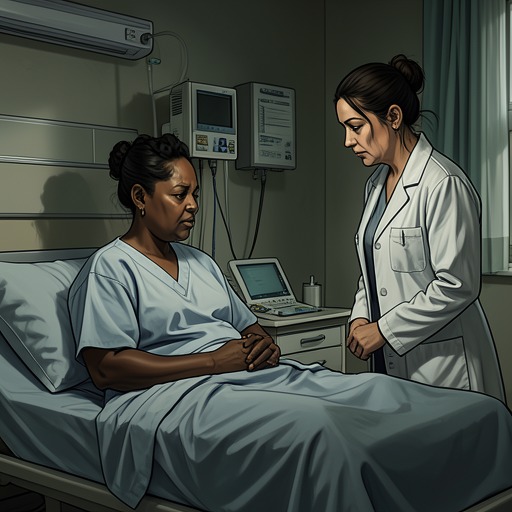
Angela McManus
Five Days at MemorialAngela McManus’s experience during Hurricane Katrina turns a daughter’s commitment to care into a struggle over what a DNR order means, who gets to speak for a patient, and what happens when a family advocate is forced away from the bedside. At LifeCare Hospitals, she had spent more than a year caring for her mother, Wilda McManus. During the evacuation crisis at Memorial Medical Center, Angela understood her mother’s limits on resuscitation as decisions about futile treatment—not permission to leave her without care or rescue. After Wilda died, Angela became a public voice for her mother and sought an account of what had happened, while acknowledging that she did not know whether her mother had died from infection or from someone’s intervention.
Caregiver and Advocate
Wilda had been a longtime patient information manager at Charity Hospital, but a stroke and the effects of medication made it difficult for her to communicate. Her daughter had left her job and spent more than a year as her caregiver. The hospital paperwork specified that Angela was to stay with Wilda at all times, reflecting how central her presence had become to her mother’s care.
Angela’s advocacy was practical as well as emotional. She fed Wilda through a feeding tube, changed her colostomy bag, and tried to keep her clean despite the lack of running water. When Wilda’s fever broke, Angela found that her mother was sweaty and that her wound needed attention. It took hours to find a nurse who could help wash her, dry her, and change the dressing. Angela continued talking, singing, and praying with her as she worked. Before the storm, Wilda had led prayers that staff called church; now those familiar prayers were part of the care Angela could still provide.
Angela did not treat every life-prolonging intervention as automatically beneficial. After consulting the infectious-disease specialist on duty when the storm hit and Wilda’s infection worsened, she agreed against surgery in an operating room running on backup power. She also accepted that resuscitation would not resolve her mother’s chronic underlying conditions. But agreeing not to use surgery, breathing tubes, electric shocks, or chest compressions was not, for Angela, a decision to withdraw ordinary care or to give up on her mother’s remaining life. She found value in Wilda’s quieter, less active existence and saw her own role as protecting her mother’s comfort, dignity, and chances for care.
The DNR Decision and the Delayed Evacuation
Memorial Medical Center’s doctors had made an exception to their general evacuation approach: patients with Do Not Resuscitate orders would be evacuated last. Wilda had such an order, and Angela learned that the designation could leave her mother behind while other patients were carried out. She pleaded with LifeCare staff to revoke it, but was told no doctor was available to do so. The crisis exposed the distance between a family’s understanding of a DNR order and the operational consequences of using it to rank patients for rescue.
Through Wednesday, Angela and Wilda watched other LifeCare patients being carried toward the stairwells ahead of her mother. Some nurses returned in tears after patients died during transport. Staff members were exhausted and frightened; some searched for phone service to reach their families, while others struggled to manage the needs of visitors and patients. Amid this disorder, a nurse’s dog barked nearby, and a cat escaped from a shower stall. Wilda, still able to speak at times, told Angela to quiet the dog. The episode gave a stark, ordinary shape to the strain around them: patient care was competing with the staff’s own fears, their responsibilities outside the hospital, and the absence of dependable resources.
Late Wednesday afternoon, Angela was told the remaining patients would soon leave and that she herself should go by boat. She asked where Wilda would be taken. LifeCare nurse executive Therese Mendez could not tell her, so they tried to attach Angela’s contact information to Wilda. A permanent marker would not write on her wet skin; instead, staff put phone numbers and an urgent message identifying Angela as her daughter on pieces of gauze wrapped around Wilda’s arm and leg. Angela took comfort in hearing staff say they could not leave until every patient was gone, but she still had no firm destination or assurance about her mother’s transport.
Separation and Medication
Angela remained close to Wilda as the evacuation continued. On Thursday, she returned to the seventh floor and found her mother in the hallway near the nursing station, receiving a cooling alcohol rubdown. Wilda was lethargic. Angela learned that patients had been given Ativan and warned staff that her mother had previously reacted badly to it, becoming more agitated rather than calmer. This time, she noticed that it appeared to have calmed Wilda. The earlier dose had been administered shortly before midnight, while Angela was away; she had not been there to warn the nurse about that prior reaction.
Later, men who said they were evacuating the hospital ordered Angela to leave Wilda’s bedside. She refused at first. When she realized she had to go, she roused her mother and explained that she was being made to leave. Angela tried to comfort Wilda by speaking of family members who would be waiting for her in the afterlife. Wilda asked her daughter to sing. Angela sang the gospel song Near the Cross, as she had when they prayed together, and Wilda closed her eyes.
LifeCare physical-medicine director Kristy Johnson came upstairs to escort Angela down. With a flashlight, she guided her through the dim stairway and helped carry her bags; they descended slowly, stopping to rest between floors. At the first floor, Johnson led Angela through the crowd to the front of the boat line, where a place was found for her as a passenger traveling alone. The evacuation had separated Angela from the person whose care had organized her life, without telling her where Wilda would go.
Johnson later described standing across Wilda’s bed from Anna Pou after Angela had been ordered downstairs. Johnson said Pou told Wilda she would give her something to feel better. Johnson looked directly at Wilda rather than at Pou’s actions on the other side of the bed. That account placed Angela’s enforced absence at the center of the later dispute: she could not observe the medication given to her mother, while the reassurance that staff would care for Wilda could not substitute for the advocate who knew her history.
Searching for an Explanation
After Wilda’s death, Angela did not claim certainty about its cause. She wondered whether the infection had killed her mother and was troubled by hearing that euthanasia might have occurred at the hospital. Her uncertainty was not indifference: she wanted to know whether death had come in its own time or had been brought about by a person. From temporary lodgings in Baton Rouge, far from her flooded family home, she made sure investigators and reporters could reach her and continued to speak about Wilda.
The prospect of regular meetings with a lawyer was too upsetting, and Angela left the decision to pursue a lawsuit to a sibling. She had little energy and struggled to recover; she found it difficult to disengage from television and felt emotionally diminished. Still, she chose to speak publicly about her mother’s treatment. In doing so, she resumed the role she had held at the bedside: being Wilda’s voice. She challenged the suggestion that the workers could know that the patients were in their final moments, particularly when those workers had not treated the patients before the disaster.
When Pou, Cheri Landry, and Lori Budo were arrested, Angela hoped the investigation might finally give her answers. Her involvement as a witness and family advocate mattered beyond her own search: a legal filing described the testimony of Angela and Kathryn Nelson, who had stayed with their mothers on the LifeCare floor until September 1, as essential to an accurate account of the conditions and care there. Angela wanted her mother’s experience to be considered as part of that record, not reduced to an abstract argument about emergency medicine.
Aftermath and Narrative Significance
The return of the grand jury left Angela without the resolution she had wanted. She spent the day crying, called relatives to tell them what had happened, and wished she had been called to testify. She continued to believe that Pou had murdered her mother. That belief is presented as Angela’s judgment, not as an established finding about Wilda’s death. The distinction is central to her story: she had been separated from Wilda at the decisive moment, did not know exactly what had been administered, and was left to seek an explanation through testimony, investigation, and public scrutiny.
Angela’s account also clarifies what she did and did not decide as a caregiver. She accepted limits on interventions she believed could not cure Wilda’s underlying conditions; she did not understand those limits as a reason to rank her mother last or deny her continued care. The distinction makes her a witness to the human consequences of the evacuation policy, rather than merely a relative opposing medical judgment. Her knowledge of Wilda’s prior reaction to Ativan, her hands-on care, and her insistence that Wilda’s life still had value give that disagreement its personal and concrete terms.
The book follows Angela from the hospital bedside to the public and legal aftermath, but the arc does not resolve into certainty. Her mother’s gauze-wrapped contact information, Angela’s song before she left, and her later effort to make investigators listen mark successive forms of advocacy under diminishing control: first tending to Wilda, then trying to remain with her, and finally speaking after she could no longer protect or question her directly. The unanswered question of how Wilda died remains inseparable from Angela’s insistence that a DNR order was never a decision to abandon her.